
Tuneko by Marie Polo
An interdisciplinary collaboration with Marie Polo that translates water and pigments into microscopic projections across live performance, spatial sound and sensory environments in Berlin, Paris and Tokyo.
- Format
- Collaboration
- Status
- Completed
- Context
- Collaboration
Tuneko by Marie Polo
All Is Only Water
Some collaborations start with a plan. This one started with an element. Water cannot be directed in the conventional sense: conditions can be set, but the material must be met, listened to and allowed to speak.
TUNEKO is Marie Polo’s interdisciplinary exploration of water. Its name derives from the French phrase “tout n’est qu’eau” — all is only water. That premise aligned naturally with Magnificent Matter’s practice of looking closely enough for nature to reveal itself as a living intelligence rather than as decoration.
The Invitation: Water as Truth, Not Theme
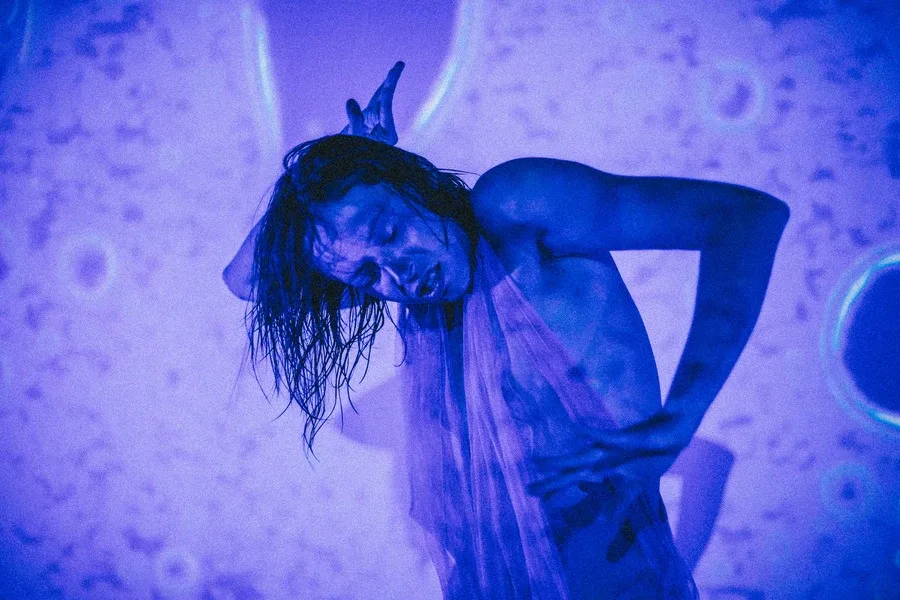
TUNEKO is not a conventional film or a finished object. It operates as a ritual ecology that combines screening, live performance, spatial sound, light, bodies and a sensory encounter with water.
Rather than using fear-based ecological messaging, the work seeks to awaken care through beauty, amazement and sensory remembering. Wonder encourages people to remain present, and that sustained attention becomes the beginning of change.
Our Role: Water, Pigments and the Microscope as Instrument
For Magnificent Matter, the microscope functions less as a clinical device than as an expressive instrument. It translates invisible material behavior into an emotional and spatial language.
The contribution to TUNEKO consisted of projected water textures and pigments generated through abstract microscopic work. The imagery was not a backdrop but another layer of water speaking: movement, diffusion and boundaries forming and dissolving without creatures, spectacle or forced metaphor.
At this scale, material behavior becomes intimate. It begins to resemble memory, currents and patterns that are felt before they can be named.
MONOM: When Precision Becomes Tenderness
The first major Berlin presentation took place inside MONOM, a space built for 4DSOUND and deep listening. Spatial sound placed the audience inside the music, allowing TUNEKO to work through closeness rather than volume.
Live performance, dancers, light, costume and set elements formed one constellation around the question of whether water could be felt again instead of merely used. The microscope projections reminded the eye that water has its own geometry.
The Reflexology Walk
Before the screening, visitors were invited to remove their shoes and enter a guided reflexology walk across sand, rock, moss, wood, cold and warmth. The gesture shifted the body from analysis toward sensation and changed how the space was entered.
Removing the protective layer of shoes became a threshold: an invitation to arrive with the nervous system rather than with the mind alone.
Monopol: The Bunker Becomes an Ocean
TUNEKO later moved from MONOM’s refined intensity into the raw industrial architecture of Monopol. The former distillery site carried its own atmosphere of history, concrete and transformation.
Within the End of Nations context, the bunker became a multisensory field of sound, light, technology and visual art. Magnificent Matter already knew this ecosystem through the Robot Koch collaboration, so TUNEKO felt like a continuation of an existing question in a different material language.
Paris and Tokyo
In Paris, the project entered 3537, an art space connected to Dover Street Market. The immersive screening, live performance, reflexology walk and spatial sound survived the translation into a different city and architectural rhythm because water and the body remained the anchors.
Tokyo provided another cultural context in which water is understood as ritual, transition and spiritual material. The project’s attention to impermanence, change and what cannot be contained connected naturally with that worldview.
What Stayed With Us
What remains is the understanding that water is not only outside us but part of how we are built; that art can invite people somatically rather than convince them intellectually; and that a microscope can become emotional while a bunker can become tender.
TUNEKO was not about making water beautiful. It was about making people available enough to remember the beauty that was already there — and to feel that care can be an instinct rather than a duty.
- Berlin venue and industrial performance environment
- Monopol
- Festival and multisensory presentation context
- End of Nations
- Paris venue
- 3537
- Concept, artistic direction and interdisciplinary performance
- Marie Polo
- Berlin venue and spatial sound environment — MONOM / 4DSOUND
- Monom Sound
Continue the exploration.
EXPO25 with Sofi Paez & ZEISS Microscopy
Live / Experience
Echoes in Orbit with Sofi Paez & Tara Nome Doyle
Live / Experience
SPIN2030
Live / Experience