
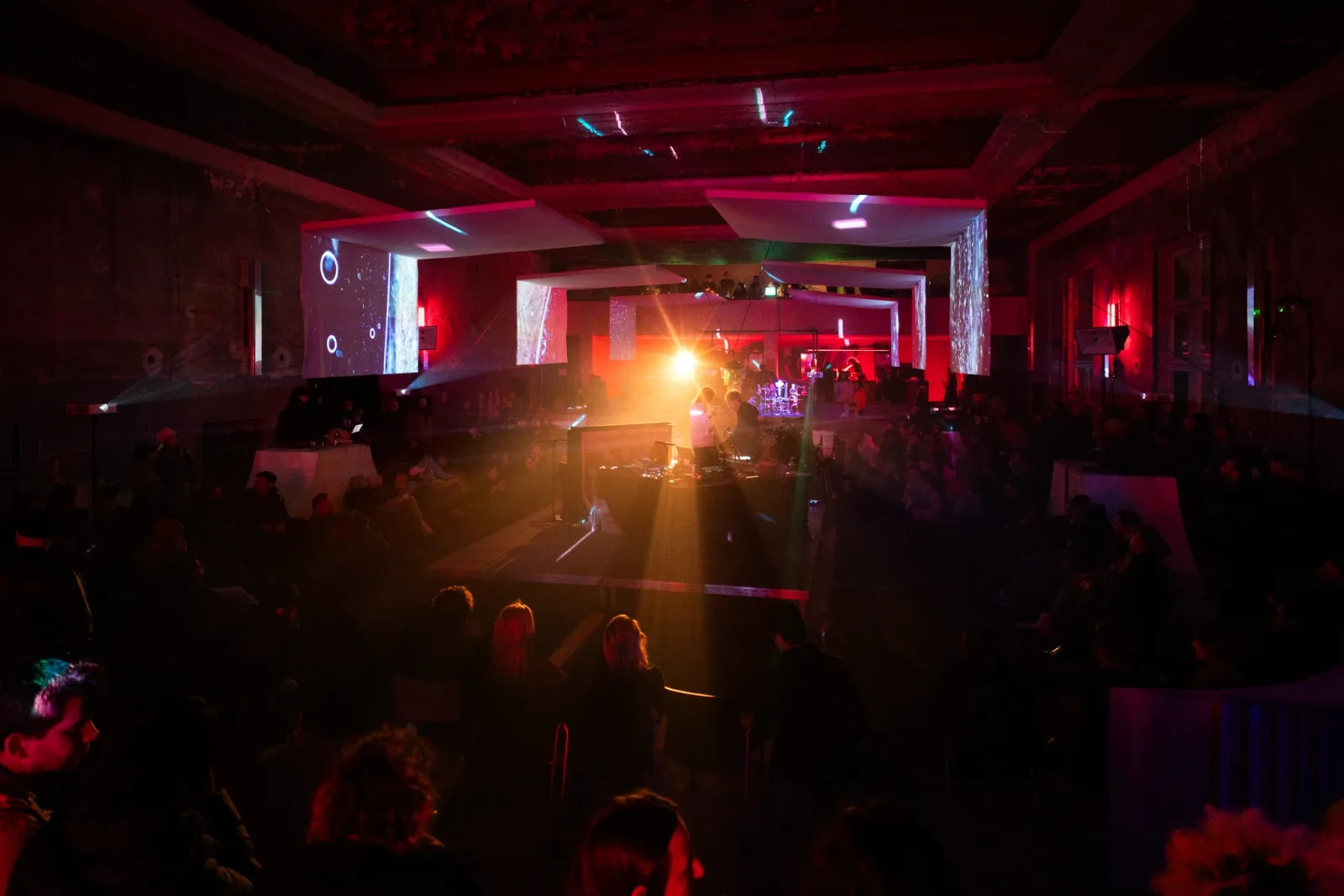
Encounters at 1-06
A two-night community-produced live event inside Berlin’s Wilhelmine theatre, bringing music, microscopic imagery, interactive installations, film, light and experimental media together as a space for human connection.
- Format
- Live / Experience
- Status
- Completed
- Context
- Live / Experience
From Isolation to a Shared Space
When the theatre became quiet again, the cables that had carried the event’s nervous system lay coiled across the floor. The glow of the screens faded into daylight, installations were dismantled, and the intensity of the previous days settled into exhaustion.
What remained was the feeling that a community had made something real.
Encounters emerged from a period in which closeness had become uncertain. The pandemic had separated people physically, but even after doors reopened, social life often remained cautious and fragmented. The project began with a desire to create something that could not be downloaded, streamed or experienced alone: a place where people could meet openly, contribute something of themselves and remember what shared physical presence can make possible.
Encounters began with an encounter.
A shared fascination with hidden worlds first brought Magnificent Matter and Robot Koch into contact during the pandemic. What started as a distant exchange gradually became the impulse to create something together in physical space.
But the event did not grow from one person, one studio or one artistic practice alone. As artists, designers, technologists and friends became involved, the original idea changed shape. Every contribution introduced a new perspective, discipline and possibility.
Encounters became what it was through this collective process: not the execution of a fixed concept, but a space formed by everyone who entered it.
The former 1-06 theatre Wilhelmine in Berlin-Schöneweide became its home.
The building had already lived several lives. Once part of a battery factory, it later served as a hospital in the GDR before standing abandoned for decades and eventually being reactivated as a cultural space. Its architecture carried the traces of those histories without attempting to conceal them. Dust, damage, scale and beauty existed together.
That honesty made Wilhelmine the right place for Encounters.
The project was never about presenting a flawless world. It created space for contradiction: fragility and power, ruin and renewal, silence and intensity, individual expression and collective responsibility. The theatre was not simply a container for the event. Its history, atmosphere and physical presence shaped how people moved, listened and related to one another.
The programme developed in much the same way. Rather than being assembled as a conventional lineup, it grew through relationships, shared interests and accumulated trust. Some contributors had worked together before. Others met through the process itself. People entered with different disciplines and levels of experience, but with a common willingness to contribute to something whose final form was still evolving.
Trust was not simply the atmosphere surrounding the project. It became its infrastructure.
A Theatre Becomes a Living Laboratory
Encounters unfolded across two nights, each revealing a different expression of the same intention.
Friday began with listening.
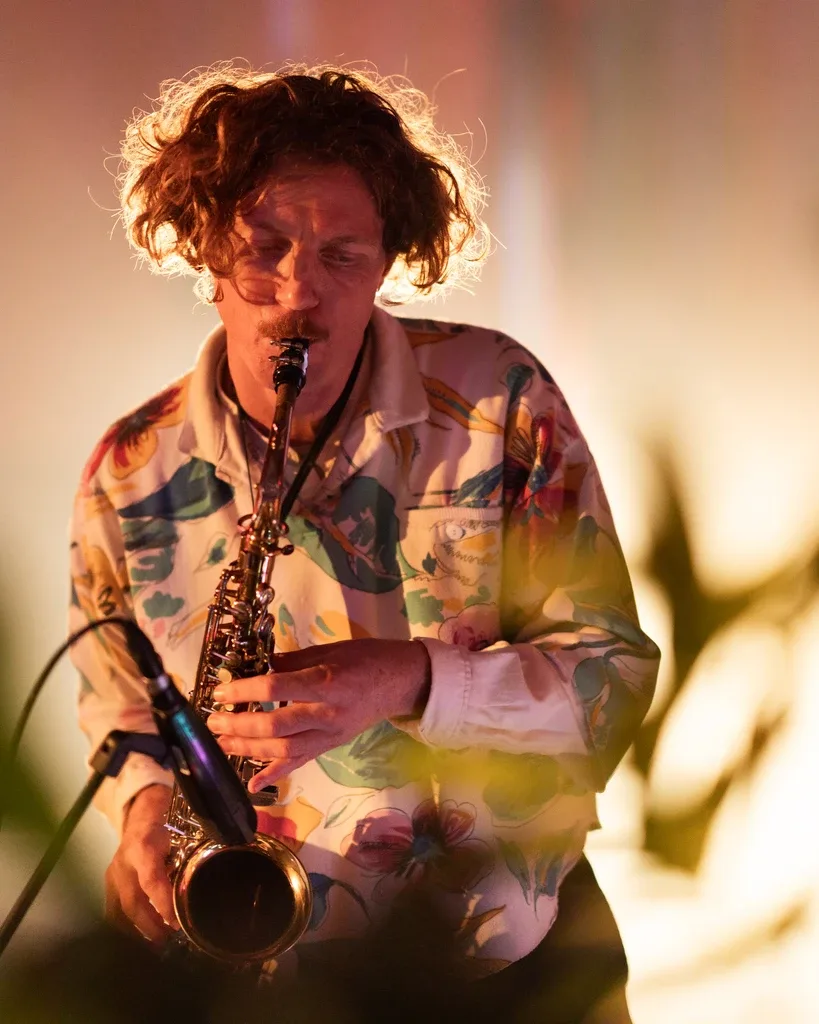
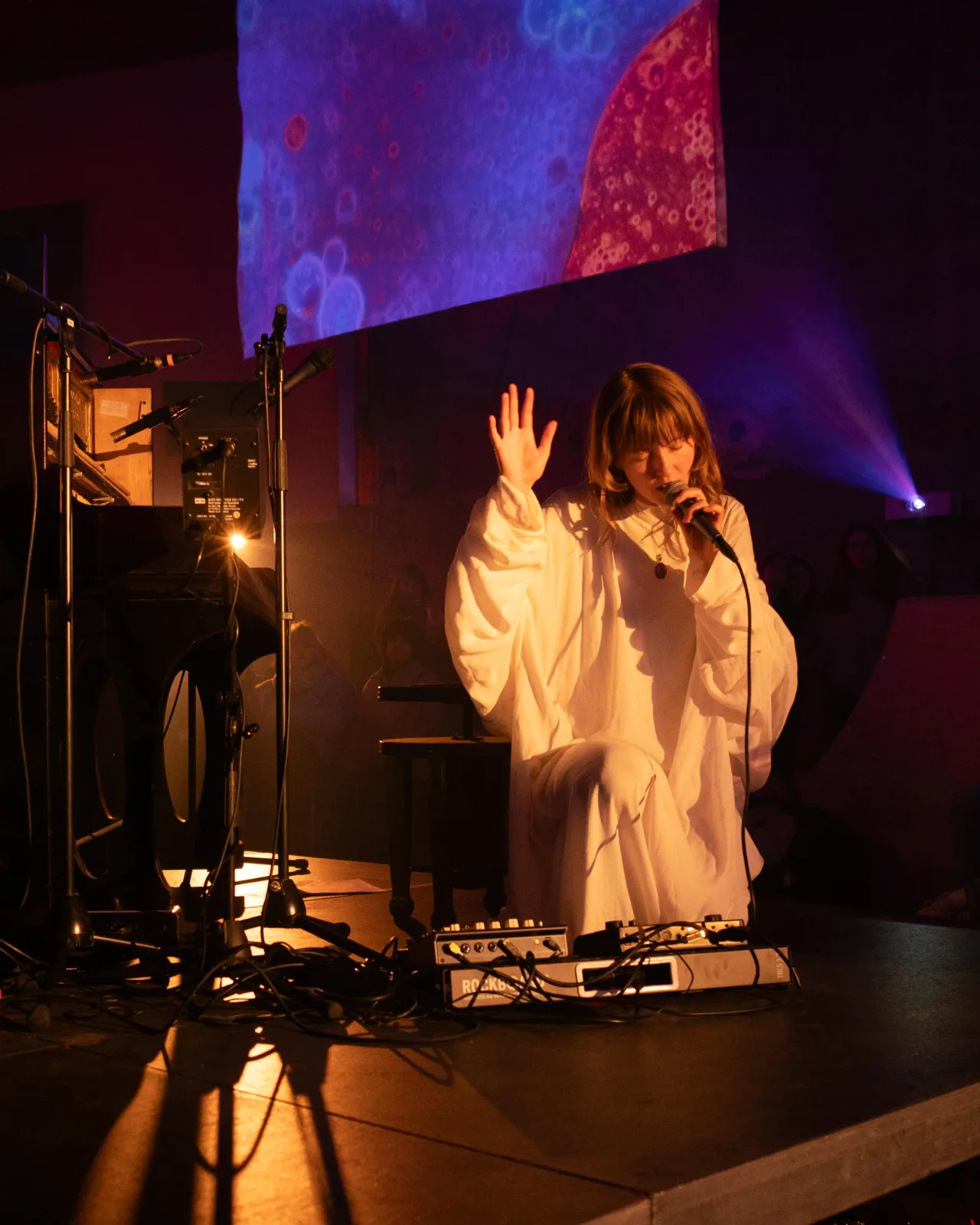
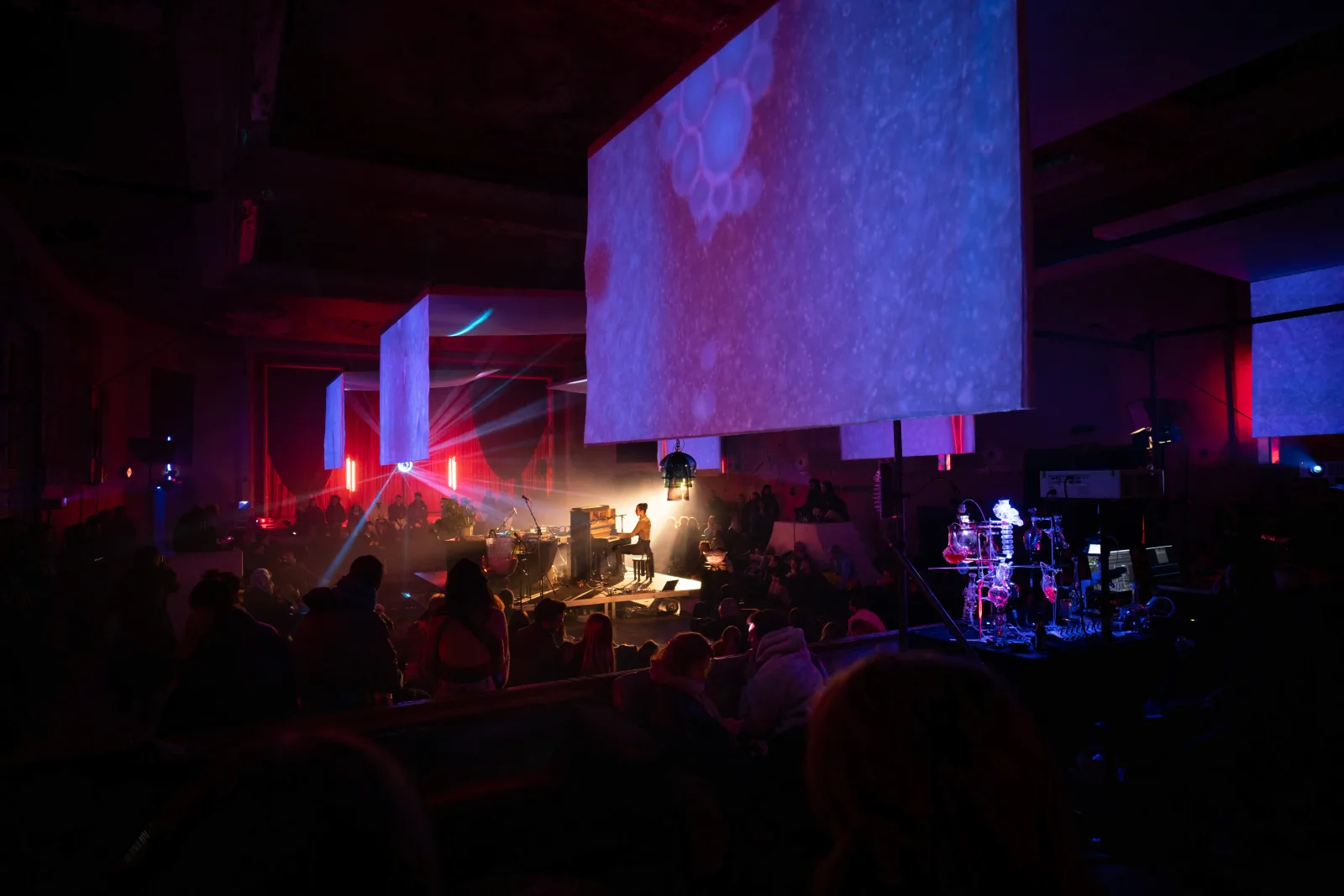
The opening night centred on sound, stillness and reunion. Robot Koch presented a pre-release performance of Allow , marking his first live appearance in Berlin in six years. His ambient work created an environment that could be deeply immersive without isolating the individual listener from the room around them.
The music became a form of social architecture.
People could surrender to it completely while remaining aware of the bodies and conversations around them. Listening was not separated from gathering. Sound created the conditions for softness, attention and shared presence — a space in which people could arrive gradually and experience intimacy without demand.
On Saturday, the theatre transformed into a laboratory.
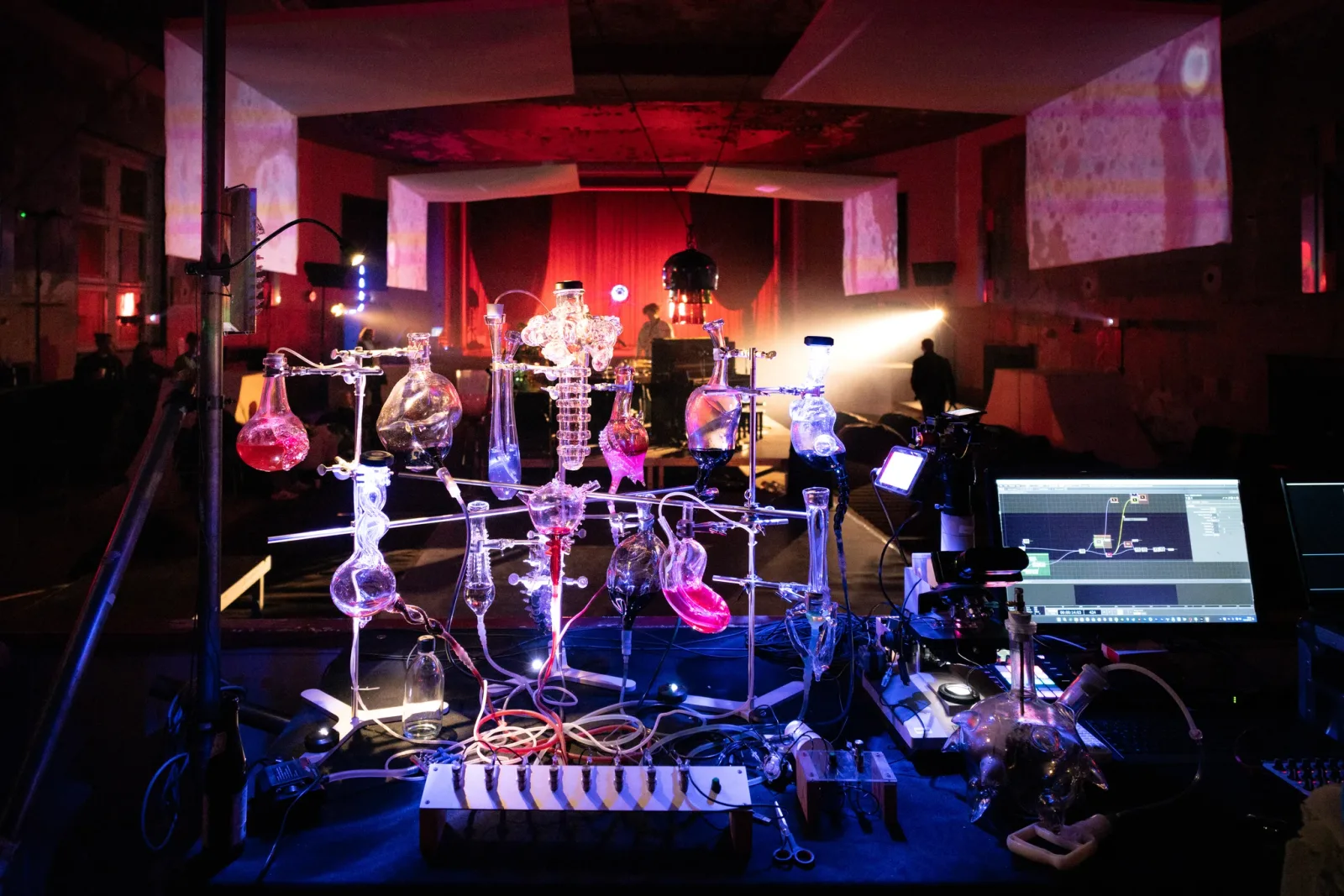
Interactive installations, moving images, lasers, sculpture and analog technologies filled the building. These works were not conceived as decoration around a programme. They were instruments for encounter: structures through which people, materials and artistic disciplines could meet.
Echo Screens , created by Kimo Slice and The Real Studio, brought together 21 CRT monitors in a flickering analog landscape. The installation carried the warmth and instability of older image technologies, allowing distortion, repetition and imperfection to become part of the experience.
Elsewhere, an initial laser experiment evolved into a collaboration between Stav, Jesse and stone sculptor Tobia Silvotti. Light, glass and marble brought radically different material timescales into contact. The work gained its strength by allowing each collaborator and each material to retain its own logic.
A beam of light could exist beside the weight of stone. Precision could coexist with unpredictability. Meaning emerged between the elements rather than belonging entirely to any one of them.
The same willingness to work with uncertainty shaped Stefano Canavese’s contribution. His short film was combined with audio-reactive lasers developed together with Amin. The two systems were tested as a complete work only shortly before the audience entered.
The outcome was not guaranteed.
That uncertainty was not treated as a failure, but as part of the artistic process. Encounters created a context in which experimentation could remain visible — where glitches, instability and risk were not automatically removed in pursuit of a polished product.
Across the theatre, disciplines met without being collapsed into one another. Film did not become a background for technology. Sculpture was not reduced to scenography. Sound was not merely accompaniment. Each practice maintained its own integrity while contributing to a larger shared environment.
The same principle shaped the production itself.
Responsibility moved across the group. People did not only complete isolated tasks; they took ownership of entire parts of the event, solved problems independently and supported work beyond the boundaries of their own disciplines.
The project operated less like a hierarchy than a living network. Specialists worked at different scales, responding to one another and moving around a shared intention. Knowledge, equipment, labour and responsibility circulated through the group.
The process was ambitious, improvised and frequently difficult.
There was no commercial backing proportionate to the scale of what the group wanted to create. Limited time, personal finances, technical uncertainty and the pressure of everyday life remained present throughout the production. People worked intensely and, at times, close to their limits.
It would be easy to romanticise this commitment afterwards, but exhaustion was part of the reality. Encounters existed because people repeatedly decided that the work was meaningful enough to continue — not because the conditions were easy or sustainable.
What Remains After the Event
For two nights, Wilhelmine became a temporary world shaped less by status, scarcity or commercial exchange than by attention and contribution.
People offered equipment, knowledge, labour, ideas, food, time and care. They stayed longer than expected, solved problems that were not formally theirs and helped carry the project through moments of uncertainty.
The richness of the event was not measured by what had been purchased, but by what people were willing to make available to one another.
This was the quiet utopian dimension of Encounters.
Not the fantasy of a world without difficulty, but the experience of a different way of organising one. A world in which trust could become operational, community could become infrastructure and artistic practice could create forms of connection that ordinary social life does not always make room for.
Encounters demonstrated that physical gatherings still matter precisely because they are inefficient, demanding and impossible to fully control. They require travel, preparation, compromise and vulnerability. They place people in situations that cannot be paused or optimised.
That is also where their value lies.
The project showed that sound can hold both immersion and social presence. That materials carry histories and emotional languages of their own. That risk is essential to genuine experimentation. That collaboration becomes stronger when expertise is respected rather than flattened. And that the feeling of having created something meaningful can coexist with an honest recognition of the labour it required.
Encounters did not offer an escape from reality.
It created a concentrated experience of it: bodies in a room, fragile technologies, accumulated histories, unresolved tensions, moments of beauty and the unpredictable energy produced when people decide to build something together.
The event ended, but the network that created it did not.
What remains is the question of what could grow from the same foundation with more time, care and support. The ambition is not simply to repeat an event, but to cultivate recurring spaces in which artistic research, human connection and shared responsibility can continue to meet.
More meeting points. More experiments. More places where people can encounter one another on eye level.
Not as audiences and producers, experts and outsiders, or individuals competing for attention, but as participants inside something that can only exist because they are there together.
- Beteiligter aus Dänemark
- Ayo Schøenherr
- Photography
- Kai Bernstein
- Beteiligter aus der TouchDesigner-Community
- Function Store
- Co-founder, concept and production
- Alex
- Steinbildhauer und Mitentwickler des „Unidentified Living Object“
- Tobia Silvotti
- Beteiligtes Studio
- DEREAL Studio
- Veranstaltungsort beziehungsweise beteiligte Kulturstruktur
- 1-06
- Co-founder, concept and production
- Maximilian Schertz
- Beteiligte Struktur aus der TouchDesigner-Community
- Function Store
- Künstler, Entwickler von „Echo Screens“
- Kimo Slice
- Filmemacher
- Stefano Canavese
- Musiker und Live-Performer
- Robot Koch
- Person
- Isabelle Jorrasch
- Person
- Amin
- Person
- Jesse
- Künstlerin
- Meredi
- Ansprechpartnerin bei 1-06
- Anja
- Beteiligter Künstler und Mitentwickler einer Installation
- Stav
Continue the exploration.
EXPO25 with Sofi Paez & ZEISS Microscopy
Live / Experience
Echoes in Orbit with Sofi Paez & Tara Nome Doyle
Live / Experience
SPIN2030
Live / Experience